.
Cover of "Real Late Starter" by Nerina Pallot . Performed by Josie Lloyd on Kora (West African Harp).
www.myspace.com/josielloydkorasongs
.

Raag Malkauns - Shafqat Ali Khan
.
Classical Indian Vocals - Shafqat Ali Khan : Event hosted by the Canada Pakistan Association at University of Ottawa , Alumni Theatre, 2009 - 12:00, 16:00, 21:54, tabla: 25:00 .
Khyal (or Khayal ) is the modern genre of classical singing in North India. Its name comes from an Arabic word meaning "imagination". It is thought to have developed out of the qawwal singing style. It appeared more recently than dhrupad , is a more free and flexible form, and it provides greater scope for improvisation .
Khyal bases itself on a repertoire of short songs (two to eight lines); a khyal song is called a bandish. Every singer generally renders the same bandish differently, with only the text and the raga remaining the same. The compositions cover diverse topics, such as romantic or divine love, praise of kings or gods, the seasons, dawn and dusk, and the pranks of Krishna, and they can have symbolism and imagery . The bandish is divided into two parts — the sthayi (or asthayi) and the antara. The sthayi often uses notes from the lower octave and the lower half of the middle octave, while the antara ascends to the tonic of the upper octave and beyond before descending and linking back to the sthayi . The singer uses the composition as raw material for improvisation, accompanied by a harmonium playing off the singer's melody line, a set of tabla, and a drone in the background. The role of the accompanist playing the melody-producing instrument is to provide continuity when the singer pauses for breath, using small variations of the singer's phrases or parts thereof.
A typical khyal performance uses two songs — the bada khyal or great khyal, in slow tempo , comprises most of the performance, while the chhota khyal (small khyal), in fast tempo , is used as a finale and is usually in the same raga but a different rhythmic pattern. The songs are sometimes preceded by improvised "alap" to sketch the basic raga structure without drum accompaniment; alap is given much less room in khyal than in dhrupad. Uploaded by "tasawwuf".
Christopher Herwig Photography: "The Soviet Roadside Bus-stops "
.
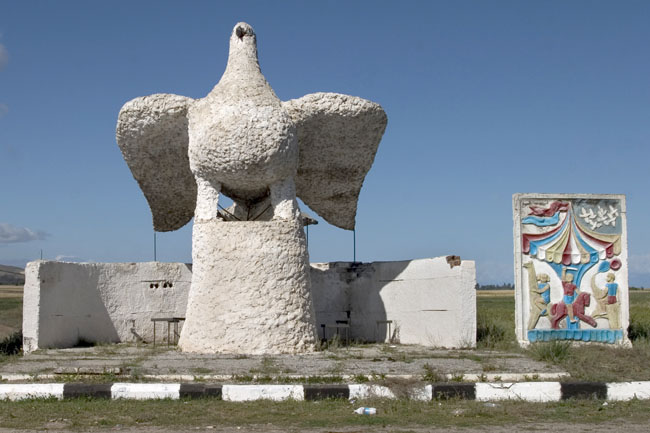
The Soviet Roadside Bus-stops
Departure from the common and boring , Next stop the wild and crazy
For the most part Soviet architecture and design is remembered for its heavy block buildings and functionally Spartan designs. Its overpowering desire for conformity left little room for individual creative freedom. A notable exceptions to this is in the transportation sector. One can admire this creativity in the Metro stations of cities like Moscow and Tashkent where the coldness and sterility of typical soviet urban architecture is abandoned and costs are not spared as creative freedom is unleashed. While many of us are aware of the elaborate splendor of the Moscow underground, it is easy to overlook the phenomenon of the common roadside bus stop as an example of soviet art and design letting loose and becoming a little weird and crazy. .... ( more )
Subscribe to:
Comments (Atom)