.
John Zorn - direction
Marc Ribot - guitar
Jamie Saft - piano, organ
Trevor Dunn - bass
Kenny Wollesen - vibraphone
Joey Baron - drums
Cyro Baptista - percussion
Uploaded by "uvisni" November, 2010 .
.


Shafqat Ali Khan - " Ishq Anokhri "
.
Shafqat Ali Khan performs a Kaafi by Ghulam Farid at BBC Bush House, London, with Nafees Irfan on Tabla. Recording Engineer: John Andrew. Shot by Mazhar Zaidi, Directed and Edited by Nofil Naqvi. Uploaded by "nofiln", 2007 .
Shafqat Ali Khan performs a Kaafi by Ghulam Farid at BBC Bush House, London, with Nafees Irfan on Tabla. Recording Engineer: John Andrew. Shot by Mazhar Zaidi, Directed and Edited by Nofil Naqvi. Uploaded by "nofiln", 2007 .
Shafqat Ali Khan (Born June 17, 1972 Lahore Pakistan) belongs to the Sham Churasi school from East Punjab. This school of music has a long tradition that dates to the Mughul times of Emperor Akbar. This school was established by the two brothers Chand Khan and Suraj Khan. His uncle Ustad Nazakat Ali Khan and father Ustad Salamat Ali Khan, the internationally acclaimed classical singers, from the 10th generation of the Sham Churasi school.
Shafqat began performing at the age of seven. His first performance was at the Lahore Music Festival. Shafqat has performed throughout Europe with several important concerts in France, the United Kingdom, Italy, Germany, Holland, Spain, and Switzerland Geneva Festival. He is a well established performer throughout India, Pakistan, and Bangladesh. He has performed as well Canada and the United States with some key performances at the Smithsonian Institute in the 1988 and 1996, and for the World Music Institute at the New York's Metropolitan Museum in 1988 and Merkin Concert Hall in 1991.
Shafqat in the recipient of a number of awards, in 1986 in Lahore he received the Amir Khusrau Award as the best young classical singer. In 1987, he received the Gold Medal from Faislabad University, Pakistan. In 1995 he received the Ghanda Award from New Deli University. He has appeared on recordings from Nimbus(UK), EMI( India), HMV( UK), WaterLily Acoustics (USA), Westron (India), MegaSound( India), Keytune Productiona (Holland), Plus Music India) (forthcoming), and Folk Heritage (Pakistan).
.
Florian Hecker- " Pentaphonic Dark Energy" , 2008 .
.
Florian Hecker: Pentaphonic Dark Energy from The Wire Magazine on Vimeo.
Florian Hecker: Pentaphonic Dark Energy from The Wire Magazine on Vimeo.
..." each work Hecker deliberately disrupts or distorts the usual order of our listening experiences, constructing a series of events in which fixed points and final decisions about what is heard slip out of reach. This is at its most immediate in Auditory Scene (2010), in which five loudspeakers placed at varying heights play a sequence of fast-paced tones, each starting at different points. At first the blurred, skittering sounds are baffling; further listening patterns them into impossible shapes that become almost compulsively elusive. In Untitled (2010), placed opposite, the loudspeaker shoots a single tone onto a ceramic-tiled section of the wall, creating a forcefield of oscillating sound. If the first of these is introspective, inviting a personal, physical response, and the second more concerned with the properties of the space and the physics of surfaces " .... ( More )
.
Boubacar Traoré & Ballaké Sissoko
.
From the documentary " Je Chanterai Pour Toi " with Boubacar Traore ( vocal ) and Ballake Sissoko ( Chora ) . Uploaded July 2010.
.
From the documentary " Je Chanterai Pour Toi " with Boubacar Traore ( vocal ) and Ballake Sissoko ( Chora ) . Uploaded July 2010.
.
Kurt Elling - " Nature Boy "
.
Kurt Elling and the Laurence Hobgood Trio, featuring Ernie Watts, Live in Umbria Jazz Winter, Orvieto Italy, Jan. 4th,2010.Posted by "MarioMaccaferriRules".
.
Kurt Elling and the Laurence Hobgood Trio, featuring Ernie Watts, Live in Umbria Jazz Winter, Orvieto Italy, Jan. 4th,2010.Posted by "MarioMaccaferriRules".
"One of the few male jazz singers from around the baby boom generation, Kurt Elling is an anomaly simply by profession. Given the depth and broad vision of his recordings and performance style, Elling is in a league of his own. Planning a career in the academic world, he discovered jazz and took to it naturally. Deeply influenced by singer and poet Mark Murphy, Elling began to develop his idiosyncratic scat style in the smaller clubs of Chicago (primarily at the Green Mill, sharing the stage with legends Von Freeman and Ed Peterson) and then throughout the Midwest. An Elling show can contain ranting beat poetry, dramatic and poignant readings of Rilke, and hard-swinging scat. After sending a demo to Blue Note, Elling signed to the label and issued Close Your Eyes in 1995. He began to get attention from the jazz press, not only for his talent and original style, but also for his choice in sidemen, which included Laurence Hobgood and Paul Wertico for a time."..... ( Thom Jurek, Rovi )
.
Garikayi's M'biras - Marenje song with different tunings
.
Mavembe tuning - 02:58 , Nhemamusasa tuning - 03:48 , low Mahororo tuning - 04:37, Nyabango tuning - 05:15, high Mahororo - 06:20.
Uploaded by Michal Shapiro July 2010 .
.
Mavembe tuning - 02:58 , Nhemamusasa tuning - 03:48 , low Mahororo tuning - 04:37, Nyabango tuning - 05:15, high Mahororo - 06:20.
Garikayi is a Zimbabwean mbira maker, a woodcarver, carpenter and metal worker. He is also a highly inventive and creative player of the mbira, the traditional "thumb piano" of the Shona people. Playing both acoustic and electrified mbira--using a pick-up--Garikayi takes the traditions of the past and evolves them through his own life experience. He is a unique composer, a dreamer of music who sings sweetly in the voices of his ancestors.
The compositions of Garikayi are heard weekly in the village near Harare where he lives and plays the mbira dances for the community. These mbiras last through the night, dance parties of traditional music for the youth. Fables and stories of timeless truth are celebrated through the mbira, played so their wisdom is easily absorbed by the next generation. Garikayi's compositions keep these principles alive and relevant for people today. In 2003, he released his international debut recording, Maidei (Limitless Sky). It is a powerful presentation of this highly spiritual music's universal appeal.
Uploaded by Michal Shapiro July 2010 .
.
Josie Lloyd on Kora - "Real Late Starter"
.
Cover of "Real Late Starter" by Nerina Pallot . Performed by Josie Lloyd on Kora (West African Harp).
www.myspace.com/josielloydkorasongs
.
Cover of "Real Late Starter" by Nerina Pallot . Performed by Josie Lloyd on Kora (West African Harp).
www.myspace.com/josielloydkorasongs
.
Raag Malkauns - Shafqat Ali Khan
.
Classical Indian Vocals - Shafqat Ali Khan : Event hosted by the Canada Pakistan Association at University of Ottawa , Alumni Theatre, 2009 - 12:00, 16:00, 21:54, tabla: 25:00 .
Khyal (or Khayal ) is the modern genre of classical singing in North India. Its name comes from an Arabic word meaning "imagination". It is thought to have developed out of the qawwal singing style. It appeared more recently than dhrupad , is a more free and flexible form, and it provides greater scope for improvisation .
Khyal bases itself on a repertoire of short songs (two to eight lines); a khyal song is called a bandish. Every singer generally renders the same bandish differently, with only the text and the raga remaining the same. The compositions cover diverse topics, such as romantic or divine love, praise of kings or gods, the seasons, dawn and dusk, and the pranks of Krishna, and they can have symbolism and imagery . The bandish is divided into two parts — the sthayi (or asthayi) and the antara. The sthayi often uses notes from the lower octave and the lower half of the middle octave, while the antara ascends to the tonic of the upper octave and beyond before descending and linking back to the sthayi . The singer uses the composition as raw material for improvisation, accompanied by a harmonium playing off the singer's melody line, a set of tabla, and a drone in the background. The role of the accompanist playing the melody-producing instrument is to provide continuity when the singer pauses for breath, using small variations of the singer's phrases or parts thereof.
A typical khyal performance uses two songs — the bada khyal or great khyal, in slow tempo , comprises most of the performance, while the chhota khyal (small khyal), in fast tempo , is used as a finale and is usually in the same raga but a different rhythmic pattern. The songs are sometimes preceded by improvised "alap" to sketch the basic raga structure without drum accompaniment; alap is given much less room in khyal than in dhrupad. Uploaded by "tasawwuf".
Christopher Herwig Photography: "The Soviet Roadside Bus-stops "
.
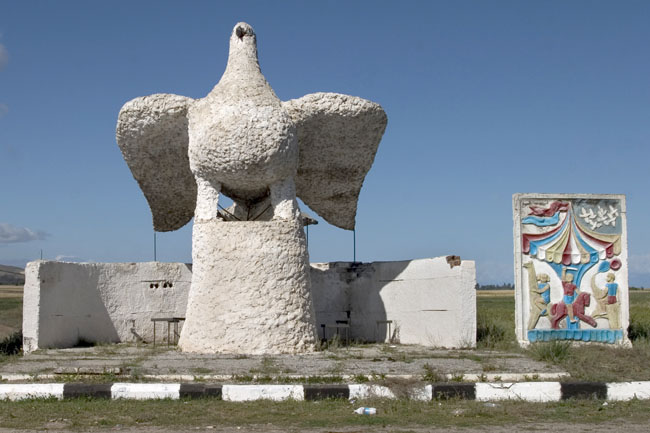
The Soviet Roadside Bus-stops
Departure from the common and boring , Next stop the wild and crazy
For the most part Soviet architecture and design is remembered for its heavy block buildings and functionally Spartan designs. Its overpowering desire for conformity left little room for individual creative freedom. A notable exceptions to this is in the transportation sector. One can admire this creativity in the Metro stations of cities like Moscow and Tashkent where the coldness and sterility of typical soviet urban architecture is abandoned and costs are not spared as creative freedom is unleashed. While many of us are aware of the elaborate splendor of the Moscow underground, it is easy to overlook the phenomenon of the common roadside bus stop as an example of soviet art and design letting loose and becoming a little weird and crazy. .... ( more )
Arvo Pärt - Da Pacem Domine
.
Tallinn Chamber Orchestra & Estonian Philarmonic Chamber Choir
Tonu Kaljuste, conductor
November, 2008 (New York City)
Video produced by Kinetic Media NYC for ECM Records USA www.KineticMediaNYC.com
.
Tallinn Chamber Orchestra & Estonian Philarmonic Chamber Choir
Tonu Kaljuste, conductor
November, 2008 (New York City)
Video produced by Kinetic Media NYC for ECM Records USA www.KineticMediaNYC.com
.
Photojournalist - Q. Sakamaki :"Haitian Quake Survivors - Homes "

"This is a portrait story of Haitian internal displaced people, IDP, of the February 12th mega earthquake that killed 230,000 people. And people in this story are those of newly created one million and 200,000 homeless in/ around Port au Prince, the capital of the country.
I started to photograph them 6 days after the quake, in Pont-Rouge, one of the biggest earthquake refugee camps, probably the biggest: the number of the IDP is tens of thousand. They were so hungry and so thirsty when I first visited the camp. Nearly everyone asked me food and water, putting their hands on stomachs and saying “Grangou,” or (I am) very hungry in English. At the same time they were very tough and resilient people. Despite their starving, they started to build their own shelter by themselves, using shabby cloths, woods, plastic bags and whatever available... ( more )
 Q. Sakamaki is a New York-based Japanese photographer. He has covered both U.S. domestic issues and international events, particularly the deadly conflicts and human rights issues. His photographs have appeared in books and magazines worldwide including Time, Newsweek, and Stern, Readers Digest, and Rolling Stone and he has been exhibited in solo shows in New York and Tokyo. He has received numerous awards, including the World Press Photo, Olivier Rebbot of Overseas Press Club, and Days International Photojournalism Award. Sakamaki holds a Master’s degree in International Affairs from Columbia University in New York. He has published several books, including the late ones: “WAR DNA”, the coverage of seven different deadly conflicts, published in Japan, and “Tompkins Square Park”, a photo essay of New York’s Lower East side’s anti-gentrification movement, published by PowerHouse Books. He has also been video-documenting world events. His footage of the Liberian war used in “Liberia: An Uncivil War”, was nominated on the 26th Annual News & Documentary Emmy Awards in 2005. ( Redux Pictures )
.
Greg Sheehan and Tunji Beier- Fairbridge 2010
.
Tunji Beier on Kanjira and Greg Sheehan on Tamborine . Fairbridge Festival, Western Australia .
.
Tunji Beier on Kanjira and Greg Sheehan on Tamborine . Fairbridge Festival, Western Australia .
.
Angus and Julia Stone-"Wasted"
.
Australian brother and sister Angus and Julia Stone perform a reggae style version of their song 'Wasted' from their debut album "A Book Like This" live in the Sugar Club, Dublin.
Uploaded by "IndieRockerHippie"
.
Australian brother and sister Angus and Julia Stone perform a reggae style version of their song 'Wasted' from their debut album "A Book Like This" live in the Sugar Club, Dublin.
Uploaded by "IndieRockerHippie"
.
Vong Co : Vietnamese theater Music
.
.
Vọng cổ (literally "longing for the past") is a Vietnamese song and musical structure used primarily in the cai loung theater music and chamber music of southern Vietnam. It was composed sometime between 1917 and 1919 by a Mr. Cao Van Lau (also called Sáu Lầu or Sáu Làu), of Bac Lieu , a province in Southern Vietnam . The song achieved great popularity and eventually its structure became the basis for numerous other songs. The tune is essentially melancholy in character and is sung using Vietnamese modal inflections.
.
Doundounba party : West African Dance Party in Konakry
.
Guinee West Africa with all the local super stars showing and strutting their talents in dance.
Posted by Michael Pluznick.
.
Guinee West Africa with all the local super stars showing and strutting their talents in dance.
Posted by Michael Pluznick.
.
Asalato: Ghanaian Percussion Instrument
.
Ghanaian musician Okaidja Afroso stopped into the Traders to show us how to play the Asalato (aka Bakita, or Thelevi). Okaidja is a first call drummer, dancer, and singer among his Ghanaian peers and many others. Here's a behind-the-scenes peek into Ghanaian rhythm.....
The Kosika (also known as Kashaka, Patica, Asalato, Kes Kes, Tchangot Tche or many other names) is a simple Ghanaian percussion instrument consisting of two small gourds filled with beans (essentially, two small kinds of maracas) and connected by a string. One gourd is held in the hand and the other is swung from side-to-side around the hand, creating a "clack" upon impact. Kosika can consist of gourds or high-impact plastic filled with hard plastic beads.
The Kosikas are said to improve one's sense of rhythm, ambidexterity and eye-hand coordination, as playing the Kosika is essentially a form of juggling. Kosikas are also thought to relax, stretch and strengthen the wrists, forearms and shoulders, and can be seen as a tension-release activity, and they are the more versatile shaker percussion instruments. ( Wikipedia )
The Kosika (also known as Kashaka, Patica, Asalato, Kes Kes, Tchangot Tche or many other names) is a simple Ghanaian percussion instrument consisting of two small gourds filled with beans (essentially, two small kinds of maracas) and connected by a string. One gourd is held in the hand and the other is swung from side-to-side around the hand, creating a "clack" upon impact. Kosika can consist of gourds or high-impact plastic filled with hard plastic beads.
The Kosikas are said to improve one's sense of rhythm, ambidexterity and eye-hand coordination, as playing the Kosika is essentially a form of juggling. Kosikas are also thought to relax, stretch and strengthen the wrists, forearms and shoulders, and can be seen as a tension-release activity, and they are the more versatile shaker percussion instruments. ( Wikipedia )
Stella Chiweshe - "Rwavasekuru"
.
When the young Stella Chiweshe decided to become a m'bira player, there was major consternation from all of those around her. She says the women were as opposed to the idea as the men. As m'bira playing was entirely within the male domain, Chiweshe spent a lot of her time surrounded by men, which led the women in her village to look on her as being "loose," as she states herself. "Men played m'bira, and for me to play m'bira meant that I had to sit with men on either side of me. It made the women very uncomfortable." But, without reservation, Chiweshe remains steadfast that what she went through, her pioneering force at that time, has made her stronger throughout the other areas in her life. Certainly she broke significant new ground for the likes of Virginia Mukwesha (her daughter), Chiwoniso (daughter of celebrated m'bira player, the late Dumisani Maraire) and the countless other female musicians in Zimbabwe today who juggle the burden of the traditional female role in society with the need to perform and be heard
The combination of m'bira and marimba might seem relatively obvious nowadays, but Chiweshe is often credited as the first artist to actually bring the two together. She said she had been searching for a sound that had been evading her since her very first recording back in 1974. She knew what she wanted to hear but couldn't quite grasp how to make this particular sound happen. After almost ten years it clicked, and she now uses two marimbas to recreate the sound of one m'bira, similar to Mapfumo's idea of reconstructing the m'bira sound on guitar. Talking M'bira contains two outstanding examples of this, Chachimurenga and "Manja." But why is it that everything she does harps back to the fundamental sound of the m'bira, and what is the universal appeal of that sound? Chiweshe firmly believes that the gentle m'bira timbre is "closely related to the sound of water, something that is innately familiar to all people, and therefore the m'bira is instantly memorable and comforting. It is a total form of therapy in itself." But it is the power of the spirit of the m'bira that is most vital to Chiweshe, the power to override all the worries of this world and render them inconsequential by comparison, whether one is open to the idea or not. In the liner notes to Talking M'bira, Chiweshe tells touching stories of individuals who have come across the sound of m'bira and suddenly lost the physical pain which has accompanied their lives, and of audience members who have been moved to tears which they feel are not even their own, tears experienced by them but coming from another source within. "People do not truly understand the strength of this power. It can take you completely by surprise." She says this is why people involved in the traditional bira ceremony remove their shoes, in order to let the full extent of the spirit move them with absolute freedom, devoid of inhibition.
( Jennifer Byrne , Roots World )
Nelson Tswatswa & Samson Bvure - " ? Zviri Pai "
.
NELSON TSWATSWA & SAMSON BVURE from the album "Dandememtande " . El Sur Records , Tokyo.
Posted by CHIMURENGAINJAPAN
.
NELSON TSWATSWA & SAMSON BVURE from the album "Dandememtande " . El Sur Records , Tokyo.
Posted by CHIMURENGAINJAPAN
.
Stephan Bösch – Alpaufzug in Switzerland
.


Alpaufzug in Switzerland
Doris stands hardly on the brake. A fox mother crosses the street with her two young. We are off to Toggenburg. A valley in the northeast of Switzerland. Today is an important day for family Ammann. At around 3 o’clock in the morning we arrive the farm. The whole family sits eagerly at the breakfast table.
Every springtime the alpine farmers ascend to the higher alp with their animals. The meadows of the valley are grazed. On the alp lush meadows are waiting for the cows. The quality of the milk is better because they eat mountain herbs. That’s the reason why the taste of the alpine cheese is different.
The ascent up the Alps is celebrated according to old traditions. The farmers dress themselves in Sunday-dress. The three nicest cows wear the “Gschell”. These three bells are tonally compatible. An other important thing is the “Zäuerle” or “Jodeln”. It is a kind of alpine chant without words.
After the caravan has left the street steep serpentines lead up to the hill. From time to time the farmers get some drinks at the wayside. After a few gulps and a short talk they continue to walk quickly.
While the ascent up the Alps you realize the value of the family. The kids don’t have to go to the school. Everyone of the family helps. In the mountain chalet all sit together comfortably and eat bread, cheese and sausage. The first cow gets milked to have milk for the coffee. After this eventful day silence comes and the the hard daily work begins. ( more )
Still-Dancing Blog
Carlos Casas
.
Camera Edit, with Ambient Sound and Radio Frequencies.
Captured in location. Shortwave radio signals. KHz Range : 5000-8000 AM SW
Shot on location in Tierra del Fuego, Patagonia , in 2002.
..." Like in Smoke, another Fieldwork I filmed in Patagonia, where suddenly an AM programme started to transmit a tango classic at 4AM that was somehow filling the atmosphere too, in amazing ways. Of course I felt it so close to the image I was filming that it was somehow directing it, which brings me back to my collaboration with Phill Niblock that I will speak about later…
What is the idea behind the use of radio broadcasts on the soundtracks? Are these the main forms of communication between these isolated places and the wider world?
The use of radio frequencies came as an accident. I was using the radio to listen to some stories that were happening between isolated people in Patagonia, that also was our only way of communication, the telephone somehow. One day I started to film with the radio as a sound source, no natural sound only the radio connected to the camera. I was filming Pool, what I considerer my first Fieldwork, and the pool itself was acting as the antenna as an enhancer of the signals that were populating that place. That experience was key. I understood that radio waves inhabit the atmosphere as much as other sounds, they are an integral part, carriers of information, in a hauntological way somehow, to put it as David Toop says. Of course those sounds would have not mean so much to me if I would have not been fascinated by the work of Joe Banks and of course all the Touch approach to sound somehow.
What is fascinating is that radio frequencies in those isolated places are amazingly rich, due to the military, due to the late reflection of SW signals, and of course due to the position in the geographical sense and isolation. Of course there is a myth that accompanies all these theories about being able to listen to natural phenomena and atmospheric reactions in VLF frequencies. I am not a scientist, that is why that doesn’t worry me, I believe in it.
( The Mire, Interview with Catalan audio-visual artist Carlos Casas )
Camera Edit, with Ambient Sound and Radio Frequencies.
Captured in location. Shortwave radio signals. KHz Range : 5000-8000 AM SW
Shot on location in Tierra del Fuego, Patagonia , in 2002.
The Hypnotic Brass Ensemble
.
The Hypnotic Brass Ensemble in Time Square Station, NYC .
Posted by "mondomatic"
.
The Hypnotic Brass Ensemble in Time Square Station, NYC .
..." Apart from drummer Christopher Anderson, the eight horn-playing members of the Ensemble are all sons of jazz trumpeter Phil Cohran, who was part of Sun Ra's Arkestra during its tenure in Chicago, and went on to become one of the founders of the Association for the Advancement of Creative Musicians (AACM), the city's support group for proponents of avant-garde jazz.
"Sometimes, parents have a plan for their children that the child doesn't necessarily see till later in life," explains Hubert. "[Our father] didn't want his music to be closed out of music history – because his music informed not just Sun Ra, but Curtis Mayfield and Earth, Wind & Fire, too – so he wanted to teach his children to spread that knowledge of music, its origins, how to heal people with it, that kind of stuff. We're still trying to fill his shoes."
Cohran schooled his children from an early age, teaching them not just how to play the various horns, but the theoretical knowledge of how one note relates to the next, the principles of families of notes. By the time they started high school, they were experts compared to their peers.".... ( The Independent )
Posted by "mondomatic"
.
Orchestre Poly Rythmo de Cotonou - "Noude Ma Gnin Tche De Me "
.
From the album 'Echos Hypnotiques' volume 2. Re-mastered on Analog Africa Label. 01:47 Guitar . Posted by "Buckbumble" .
.
From the album 'Echos Hypnotiques' volume 2. Re-mastered on Analog Africa Label. 01:47 Guitar . Posted by "Buckbumble" .
Cotonou is the capital of the West African nation of Benin. In the 70s, Orchestre Polyrythmo was a household name in Benin. The group recorded dozens of songs and toured all over Africa. But they hadn’t recorded anything in decades.
Then in 2003, a German-Tunisian producer named Samy Ben-Redjeb heard some of the band’s tunes. He fell in love with the song: “Malin Kpon O.”
And he wanted to hear more of the band’s music. Ben Rejeb re-mastered a selection of their songs. This version of “Malin Kpon O ” is from his re-mastered CD. Today there are only 4 surviving members of the original band Orchestre Polyrythmo.
But they added new members and they’ve kept on playing. That’s how Radio France reporter Elodie Maillot heard them live in Cotonou. She liked their sound so much, she decided to help them tour Europe for the first time. But she knew it wouldn’t be easy.
Crazy or not, she went ahead with the plan. She even managed to get the band some badly needed horns, and guitars. This fall, the band did in fact tour Europe, their first foray outside of Africa.
The original members are all in their sixties now, but singer Vincent Ahehehinnou, says that hasn’t slowed them down.
“Just because we’re over sixty doesn’t mean we’re going to stand still on stage,” he says. “We will be grooving for the audience until we draw our last breath. You can count on us.” ( PRI's The World, hosted by Marco Werman )
Then in 2003, a German-Tunisian producer named Samy Ben-Redjeb heard some of the band’s tunes. He fell in love with the song: “Malin Kpon O.”
And he wanted to hear more of the band’s music. Ben Rejeb re-mastered a selection of their songs. This version of “Malin Kpon O ” is from his re-mastered CD. Today there are only 4 surviving members of the original band Orchestre Polyrythmo.
But they added new members and they’ve kept on playing. That’s how Radio France reporter Elodie Maillot heard them live in Cotonou. She liked their sound so much, she decided to help them tour Europe for the first time. But she knew it wouldn’t be easy.
Crazy or not, she went ahead with the plan. She even managed to get the band some badly needed horns, and guitars. This fall, the band did in fact tour Europe, their first foray outside of Africa.
The original members are all in their sixties now, but singer Vincent Ahehehinnou, says that hasn’t slowed them down.
“Just because we’re over sixty doesn’t mean we’re going to stand still on stage,” he says. “We will be grooving for the audience until we draw our last breath. You can count on us.” ( PRI's The World, hosted by Marco Werman )
.
City Boys Band
.

City Boys Band led by Obuoba J.A. Adofo Nya Asem Hwe. Ghanaian highlife music.
Osu A Meresu
Posted by "Awesome Tapes from Africa" Blog . September 27, 2009 .
.
City Boys Band led by Obuoba J.A. Adofo Nya Asem Hwe. Ghanaian highlife music.
Osu A Meresu
The City Boys International Band of Ghana is one of those typical Highlife bands that is already for a long time highly popular inside Ghana. Because of their outstanding lyrics they had huge hits in their own country.
Their music has the ingredients of very typical sharp vocals on a organ and drum Highlife sound.
Their music has the ingredients of very typical sharp vocals on a organ and drum Highlife sound.
Posted by "Awesome Tapes from Africa" Blog . September 27, 2009 .
.
Sunny Ade & His Green Spot Band -" Ija Pari "
.
Sunny Ade & His Green Spot Band from the album: Nigerias Juju Highlife at its Best - Series 2 ,1970 .
Posted by " GrooVemonster "
.
Sunny Ade & His Green Spot Band from the album: Nigerias Juju Highlife at its Best - Series 2 ,1970 .
Posted by " GrooVemonster "
.
Miguel Robles/Arvo Part - "Tabula Rasa "
.
..." 1984, the essential record of Tabula Rasa was released on ECM records. The recording features not only the title composition performed by the Lithuanian Chamber Orchestra featuring Gidon Kramer on Violin (for whom Pärt wrote the exquisitely contemplative and hypnotic title work) and Alfred Schnittke on prepared piano, but the equally beautiful composition "Cantus in Memory of Benjamin Britten" and two versions of "Fratres"; a star performance from Keith Jarrett, and Gideon Kremer and its most sublime version for 12 cellos performed by the 12 Cellist of The Berlin Philharmonic.
The compositions are sparse, but the space between the sounds are as full of music as the notes themselves. The title cut the allows an inner fullness to resonate through the most fragile, ethereal wisps of tone against the mysterious clanging of prepared piano. The lament of the tubular bells in "Cantus in Memory of Benjamin Britten" is emotionally haunting and seems to descend from the heavens above. "Fratres" is a simple tune. On one hand it sounds like something from the 15th century, yet it clearly is something from the present day." .... ( Stylus Magazine )
The compositions are sparse, but the space between the sounds are as full of music as the notes themselves. The title cut the allows an inner fullness to resonate through the most fragile, ethereal wisps of tone against the mysterious clanging of prepared piano. The lament of the tubular bells in "Cantus in Memory of Benjamin Britten" is emotionally haunting and seems to descend from the heavens above. "Fratres" is a simple tune. On one hand it sounds like something from the 15th century, yet it clearly is something from the present day." .... ( Stylus Magazine )
Harry Belafonte & Nat King Cole - " "Mama, Look A Boo Boo "
.
.
...'While I was in Jamaica on vacation recently, in one of the restaurants they had these three musicians who play traditional calypso music. And one of the songs I requested was this song. And the guy looked at me and laugh and said, " It's funny you should ask for that, because the writer of the song is right here.' One of the guitar players was indeed the writer of that song. He was about 154, he was brilliant. I was a huge fan of Belafonte, back in the Bronx. I even stole a riff, a phrase from this for a song I did when I was with Gichy Dan's Beechwood #9 " ( Kid Creole, Wire 2010 )
.
Natalie Merchant
.
From her recently released CD " Leave Your Sleep " . Live on BBC Radio, Feb 2010 .
.
From her recently released CD " Leave Your Sleep " . Live on BBC Radio, Feb 2010 .
The 26-song "Leave Your Sleep" co-produced with Merchant by Andres Levin began as a "lullaby record" and slowly transitioned into a project about childhood in general. "At that point my kid was already 5 years old and was asking questions like, 'What happens when we die?' " she says. "I wanted to be able to answer those questions musically." ( Billboard )
.
Medeski Martin & Wood - live at Jazz a Vienne, 2005
.
Medeski Martin & Wood - live at Jazz a Vienne, 2005 // a film by Emmanuel Pampuri // John Medeski - keyboards / Chris Wood - bass / Billy Martin - drums, percussion
Posted by BibiAudiofil.
.
Medeski Martin & Wood - live at Jazz a Vienne, 2005 // a film by Emmanuel Pampuri // John Medeski - keyboards / Chris Wood - bass / Billy Martin - drums, percussion
Posted by BibiAudiofil.
.
Steve Kimock with Chris Berry Trio
.
Steve Kimock with Chris Berry Trio--LIVE from Moe's Alley, Santa Cruz,California, 2/24/10
.
Steve Kimock with Chris Berry Trio--LIVE from Moe's Alley, Santa Cruz,California, 2/24/10
.
Chris Berry @ The Relix Magazine , NY City
.
Chris Berry of Pangea Performs Live In The Relix Offices In NYC...Plus An Interview About His Current Projects and Living In Zimbabwe. Shot/Edited By Jesse R. Borrell. Oct 2009 .
.
Chris Berry of Pangea Performs Live In The Relix Offices In NYC...Plus An Interview About His Current Projects and Living In Zimbabwe. Shot/Edited By Jesse R. Borrell. Oct 2009 .
.
Digital Spray
.
Work performed by the collective Digital Spray (Charlie + Highraff) at the Museo de Imagem e do Som de São Paulo (Museum of Image and Sound , Sao Paulo )
.
Digital Spray Museu imagem e som SP from gogavids on Vimeo.
Work performed by the collective Digital Spray (Charlie + Highraff) at the Museo de Imagem e do Som de São Paulo (Museum of Image and Sound , Sao Paulo )
.
John Butler Trio - Ocean (Live at Federation Square)
.
Live at Federation Square on 5th April 2007
Melbourne locals witnessed John Butler Trio Live At The Wireless in Federation Square.
.
Live at Federation Square on 5th April 2007
Melbourne locals witnessed John Butler Trio Live At The Wireless in Federation Square.
.
Diamanda Galas - " Gloomy Sunday "
.
"Saint Of The Pit" - Part 2 (Mute Records, 1986) (Restless, 1989) - Phoenix/Nomadism TV
.
Diamanda Galás (born August 29, 1955) is a Greek American born avant-garde performance artist, vocalist, keyboardist, and composer.
Known for her expert piano as well as her distinctive, operatic voice, which has a three and a half octave range, Galás has been described as "capable of the most unnerving vocal terror" .Galás often shrieks, howls, and seems to imitate glossolalia in her performances. Her works largely concentrate on the topics of suffering, despair, condemnation, injustice and loss of dignity. She has worked with many avant-garde composers, including Iannis Xenakis, Vinko Globokar and John Zorn. ( Wikipedia )
Known for her expert piano as well as her distinctive, operatic voice, which has a three and a half octave range, Galás has been described as "capable of the most unnerving vocal terror" .Galás often shrieks, howls, and seems to imitate glossolalia in her performances. Her works largely concentrate on the topics of suffering, despair, condemnation, injustice and loss of dignity. She has worked with many avant-garde composers, including Iannis Xenakis, Vinko Globokar and John Zorn. ( Wikipedia )
"Saint Of The Pit" - Part 2 (Mute Records, 1986) (Restless, 1989) - Phoenix/Nomadism TV
.
Jason Hawkes' Aerial Night Photography : New York and Las Vegas .
.

The legendary photographer Jason Hawkes sharing at Boston.com some of his latest images of American cities seen from above at night: New York City and Las Vegas , both cities that undergo significant transformations after the sun goes down.
Jason Hawkes says: ..." We flew from heights of just over 500 ft up to 2,500-ft with no doors on, it was very very cold. The images of Las Vegas were shot for a separate project, using a range of helicopters .... ″.
Check out Hawkes’ newly-released book “London at Night”. A book of his New York at night photos is due for publication in the Autumn. Captions provided by the photographer.
.

The legendary photographer Jason Hawkes sharing at Boston.com some of his latest images of American cities seen from above at night: New York City and Las Vegas , both cities that undergo significant transformations after the sun goes down.
Jason Hawkes says: ..." We flew from heights of just over 500 ft up to 2,500-ft with no doors on, it was very very cold. The images of Las Vegas were shot for a separate project, using a range of helicopters .... ″.
Check out Hawkes’ newly-released book “London at Night”. A book of his New York at night photos is due for publication in the Autumn. Captions provided by the photographer.
Posted by Siarhei Karotki, " www.theblogismine.com "
.
Dafnis Prieto Sextet
.
"Taking the Soul for a Walk", New Album released by Dafnison Music, 2008.
Dafnis Prieto, drummer and professor of Percussion at the New York University's Steinhardt School, master class videos in Latin percussion .
.
"Taking the Soul for a Walk", New Album released by Dafnison Music, 2008.
Born and trained in Cuba, Dafnis Prieto is a drum virtuoso, a masterful composer, and a rising star on the international jazz scene. His driving, mesmerizing music, which twists folk motifs into next-generation Latin jazz, is widely respected for its sophistication, its structural and harmonic complexity, and its polyrhythmic punch. His accomplished sextet includes Peter Apfelbaum (sax), Ralph Alessi (trumpet), Felipe Lamoglia (sax), Manuel Valera (piano), and Charles Flores (bass).
Dafnis Prieto, drummer and professor of Percussion at the New York University's Steinhardt School, master class videos in Latin percussion .
.
Susan Hauptman's Self portraits

Susan Hauptman’s haunting self-portraits repeatedly explore the theme of identity while demonstrating her technical mastery of drawing. For the past twenty years, she has focused almost exclusively on self-representation, documenting the aging process with attentive honesty. Her surreal use of light and color, the large scale, and juxtaposition of symbolic elements produces psychologically charged portraits.
The Artist
A native of Michigan, Susan Hauptman is one of America’s most sought-after teachers of drawing, and conducts workshops throughout the States. She has had two solo exhibits in New York’s Forum Gallery, is the recipient of numerous awards, and her work is the subject of many articles. She has work in major collections in the US, including the Museum of Modern Art, NY and the Corcoran Gallery, DC.
The self-portraits were begun in the early 1980’s as a communiqué for her husband while they were living on opposite sides of the country. Over the past 20 years, they have unfolded as a chronicle of her identity as a woman, and of the aging process that most people prefer to ignore rather than document. ( Avampato online Gallery )
Reblogged from " Figuration Feminine "
Kasai Allstars "Mbuji Mayi"
.
.
Kasai Allstars filmed in Kinshasa during the recording of the album "In the 7th moon, the chief turned into a swimming fish and ate the head of his enemy by magic". Posted by "CrammedDiscs "
Using a spectacular mixture of traditional acoustic instruments, electric guitars, distortion-laden thumb pianos and soulful vocals, Kasai Allstars is a collective revolving around 25 musicians all based in Kinshasa, DR Congo, but originating from five different ethnic groups, each with their own language and musical tradition.
Kasaï Allstars' music is powerful and sophisticated, driving and raw. Compared to Konono N°1 (whose minimal and effective sound has been massively adopted by the international electronica, world music and alternative rock scenes), Kasai Allstars use a broader array of instruments & textures, and wilder, more complex, polyrhythms. They often sound like some kind of retro-futurist primeval rock band. ( Crammed Discs )
Using a spectacular mixture of traditional acoustic instruments, electric guitars, distortion-laden thumb pianos and soulful vocals, Kasai Allstars is a collective revolving around 25 musicians all based in Kinshasa, DR Congo, but originating from five different ethnic groups, each with their own language and musical tradition.
Kasaï Allstars' music is powerful and sophisticated, driving and raw. Compared to Konono N°1 (whose minimal and effective sound has been massively adopted by the international electronica, world music and alternative rock scenes), Kasai Allstars use a broader array of instruments & textures, and wilder, more complex, polyrhythms. They often sound like some kind of retro-futurist primeval rock band. ( Crammed Discs )
.
Arild Andersen - Hyperborean (live, Til Radka, 2009)
.
Composed by Arild Andersen. From the concert "Til Radka" (tribute concert to Radka Toneff), August 10, 2009, at the Opera House during Oslo Jazz Festival, Norway. Arild Andersen, double bass, with Elin Rosseland, vocal, Arve Henriksen, trumpet and vocal, Steve Dobrogosz, piano, Jon Eberson, guitar, Jon Christensen, drums, and Alex Riel, drums. Posted by kaarekjohnsen .
.
Céleste Boursier-Mougenot
.
Commission for The Curve, Barbican, London
.
Commission for The Curve, Barbican, London
Trained as a musician and composer, French artist Céleste Boursier-Mougenot creates works by drawing on the rhythms of daily life to produce sound in unexpected ways. His installation for The Curve will take the form of a walk-though aviary for a flock of zebra finches, furnished with electric guitars and other instruments and objects. As the birds go about their routine activities, perching on or feeding from the various pieces of equipment, they create a captivating, live soundscape.
.
Bassekou Kouyate - "Ngoni Fola"
.
.
..."Malian ngoni virtuoso Bassekou Kouyate – who states that time-honoured intention to me through an interpreter, while waiting to record a live radio session at the BBC – the record in question actually achieves its goal.
In a year dominated by female-fronted electropop and breakthrough urban crossover acts, the propulsive pleasures of rock ’n’ roll have been a little hard to come by. But the momentum generated in the course of I Speak Fula (the marvellously propulsive second album by Kouyate’s seven-strong ensemble, Ngoni Ba, which includes three other ngoni players, two percussionists and his wife, the powerful singer Amy Sacko) locates the group closer to the hallowed hard rock terrain of Lynyrd Skynyrd’s Freebird than the earthenware ghetto for which the world music circuit is sometimes mistaken.
The ngoni, Kouyate’s musical weapon of choice, is a hollowed-out piece of wood, covered in dried cowhide, with four strings running up a fretless neck. It looks like a kayak paddle or a small cricket bat, and creates (in the right hands) the thrillingly kinetic ripple of a more versatile banjo. As well as teaching the ngoni at his own academy in the Malian capital Bamako, rising interest in these increasingly fashionable instruments drives Kouyate to export them to Europe. ..." ( Telegraph, UK )
In a year dominated by female-fronted electropop and breakthrough urban crossover acts, the propulsive pleasures of rock ’n’ roll have been a little hard to come by. But the momentum generated in the course of I Speak Fula (the marvellously propulsive second album by Kouyate’s seven-strong ensemble, Ngoni Ba, which includes three other ngoni players, two percussionists and his wife, the powerful singer Amy Sacko) locates the group closer to the hallowed hard rock terrain of Lynyrd Skynyrd’s Freebird than the earthenware ghetto for which the world music circuit is sometimes mistaken.
The ngoni, Kouyate’s musical weapon of choice, is a hollowed-out piece of wood, covered in dried cowhide, with four strings running up a fretless neck. It looks like a kayak paddle or a small cricket bat, and creates (in the right hands) the thrillingly kinetic ripple of a more versatile banjo. As well as teaching the ngoni at his own academy in the Malian capital Bamako, rising interest in these increasingly fashionable instruments drives Kouyate to export them to Europe. ..." ( Telegraph, UK )
.
Amampondo - " Sens'Inkoma "
.
Amampondo
Formed in 1979, Amampondo is a group from South Africa's Eastern Cape (Pondo Land) that started playing Xhosa traditional music, mostly percussion and vocals. Now it has blossomed into one of the most interesting and experimental groups in the country, opening its doors to let in the breezy jazz of Cape Town as well as a variety of other African traditional elements. The result is a remarkable blend of marimbas, drums, horns, piano and layers of male and female vocals. ( Calabash Music )
.
Amampondo
Formed in 1979, Amampondo is a group from South Africa's Eastern Cape (Pondo Land) that started playing Xhosa traditional music, mostly percussion and vocals. Now it has blossomed into one of the most interesting and experimental groups in the country, opening its doors to let in the breezy jazz of Cape Town as well as a variety of other African traditional elements. The result is a remarkable blend of marimbas, drums, horns, piano and layers of male and female vocals. ( Calabash Music )
.
Omar Sosa and Tim Eriksen - " Promised Land"
.
Three-time Grammy-nominated Cuban composer and pianist Omar Sosa has long been influenced by his African roots. On his latest album, Across the Divide, he explores how popular music was shaped by the tunes that entered two ports during the slavery years: Havana and Chesapeake Bay.
N. Scott Robinson & K. S. Resmi - Carnatic Bodhran Thani
.
N. Scott Robinson & K. S. Resmi - except from live concert featuring frame drum improvisation by N. Scott Robinson, Sep. 2008.
.
N. Scott Robinson & K. S. Resmi - except from live concert featuring frame drum improvisation by N. Scott Robinson, Sep. 2008.
.
Joanna Newsom - " Peach, Plum, Pear "
.
Sao Paulo, October 2007
Sao Paulo, October 2007
Joanna Newsom was born in January 1982 and grew up in Nevada City, California. Part of a very musical family—her mother is a pianist and her father plays guitar—her introduction to music was via the Celtic Harp. Although her first instrument was piano, Newsom began playing the harp at seven years old. She later developed an affinity for the pedal harp and became interested in composition.
Although her harp playing is not completely divorced from conventional harp techniques, she considers her style distinct from that of classically focused harpists.She has been strongly influenced by polyrhythms. Her harp teacher, Diana Stork, taught her the basic pattern of four beats against three, which creates an interlocking, shifting pattern that can be heard on "Ys", particularly in the middle section of "Sawdust & Diamonds". The media have sometimes labeled her as one of the most prominent members of the modern psych folk movement, although she does not acknowledge ties to any particular musical scene.Her songwriting incorporates elements of Appalachian music, and avant-garde modernism.
Newsom's vocal style (in the November 2006 issue of The Wire she described her voice as "untrainable") has shadings of folk and Appalachian shaped-note timbres. Newsom has, however, expressed disappointment at comments that her singing is "child-like."
Newsom's vocal style (in the November 2006 issue of The Wire she described her voice as "untrainable") has shadings of folk and Appalachian shaped-note timbres. Newsom has, however, expressed disappointment at comments that her singing is "child-like."
( Wikipidia )
Subscribe to:
Comments (Atom)